
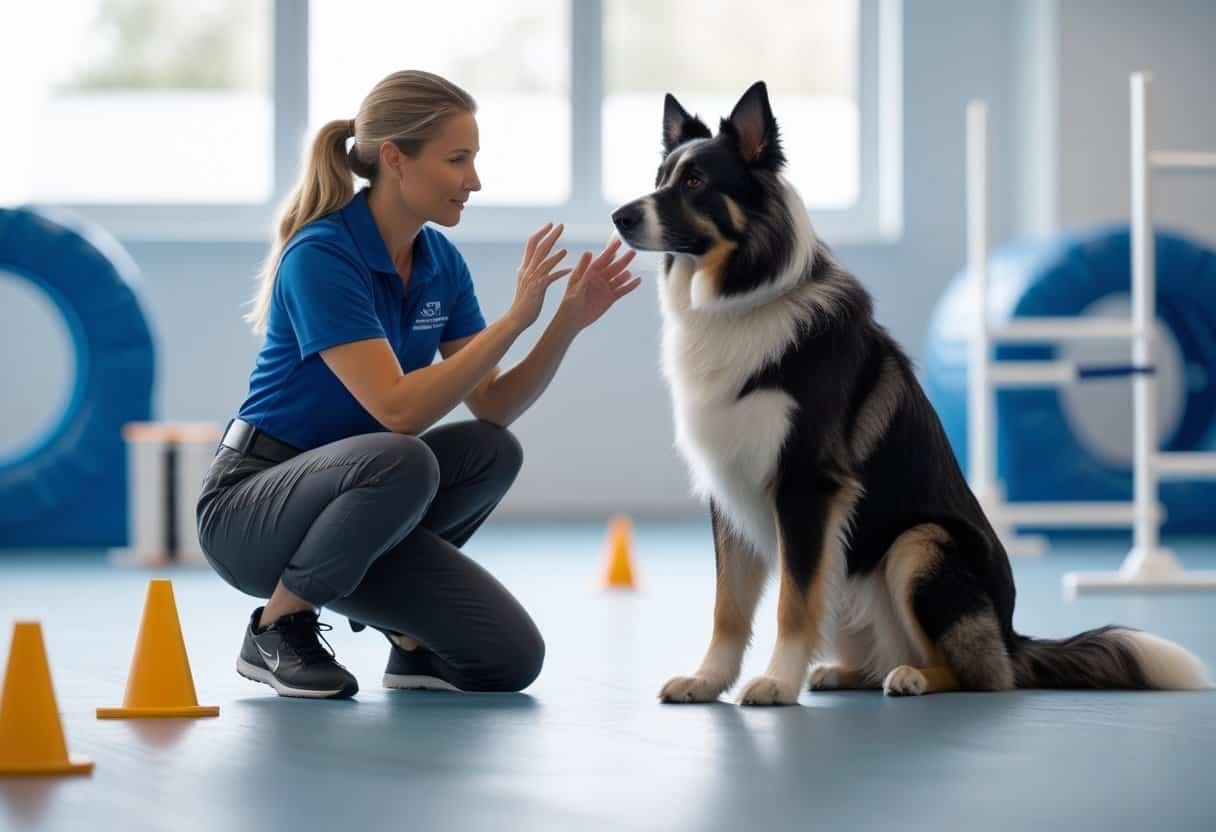

Dog-cognition studies measure several abilities rather than one household “smart” score. Results from a structured test battery do not tell you how one dog will learn a particular skill in your home.
Replace the intelligence label with an observable question
A review of working-dog cognition reported that variation across tests was better explained by several domains than by one general intelligence factor. The reviewed domains included social referencing, inhibition, cooperative communication, working memory, perceptual bias, and discrimination. This research concerns structured cognitive tasks; it does not create a household score or prove that one breed will be easier to live with.
Another study’s final sample included 1,002 adult dogs in 13 groups, one of which was a mixed-breed category. It found breed differences on some tasks and reported that variation within breed groups can be substantial. Use that evidence as population-level context, then measure the individual behavior you actually need. Read the working-dog cognition review and the breed-differences study.
Create a simple learning record
Choose one practical skill, such as settling on a mat, coming when called, or allowing grooming. Record the conditions so that improvement means something.
| Record | Example |
|---|---|
| Behavior | Four paws remain on the mat |
| Cue and setting | “Mat” in a quiet room, handler six feet away |
| Baseline | Successful in 2 of 5 trials for three seconds |
| Reinforcer | A small food reward delivered on the mat |
| Next change | Increase duration or distraction, not both at once |
Repeat under the same conditions before changing the task. If you change distance, duration, distraction, or the reward, note the change so that the results are not treated as directly comparable. Stop and seek veterinary guidance if the dog appears painful or unwell. This informal log measures one learned behavior; it is not a validated intelligence test.
Train for welfare as well as performance
The American Veterinary Society of Animal Behavior’s humane training statement says evidence supports reward-based methods for all canine training and advises against aversive methods that rely on force, pain, or emotional or physical discomfort.
- Define the behavior in observable terms.
- Start in a setting where the dog can succeed.
- Reward the desired response promptly.
- Change one difficulty at a time.
- Stop when the dog shows pain, escalating fear, aggression, or distress, and seek appropriate professional help.
For ideas beyond basic cues, see Advanced Poodle Training: Beyond Basic Obedience. Apply any exercise to the individual dog’s health, comfort, and skill level.
How to choose a trainer
Ask a trainer to describe and demonstrate the methods used, the behavior being taught, and how the approach is adapted to the individual dog. The AVSAB trainer-selection guidance recommends reward-based methods, clear explanation and demonstration, individual help, and continued education. Also verify qualifications, supervision, emergency procedures, health requirements, progress reports, owner practice, and follow-up terms for the specific program. Avoid guarantees of a permanent behavior outcome.
Day training, group classes, private sessions, remote coaching, and board-and-train programs are service formats; verify the methods and the current provider’s written policies directly. This is a generic educational article. It does not review or provide hours, prices, policies, or outcome claims for any business using “The Intelligent Canine” as a name.
What an “intelligent” response can and cannot tell you
Performance on one task is not a guarantee of reliability in a different setting. A change in results does not identify its own cause. Record what changed in the cue, setting, difficulty, and reward before drawing a conclusion about the dog, and seek appropriate professional help if pain, fear, aggression, or distress appears.
The useful goal is not to prove that a dog is intelligent. It is to identify what the dog can do now, teach one humane next step, and measure whether the plan works.