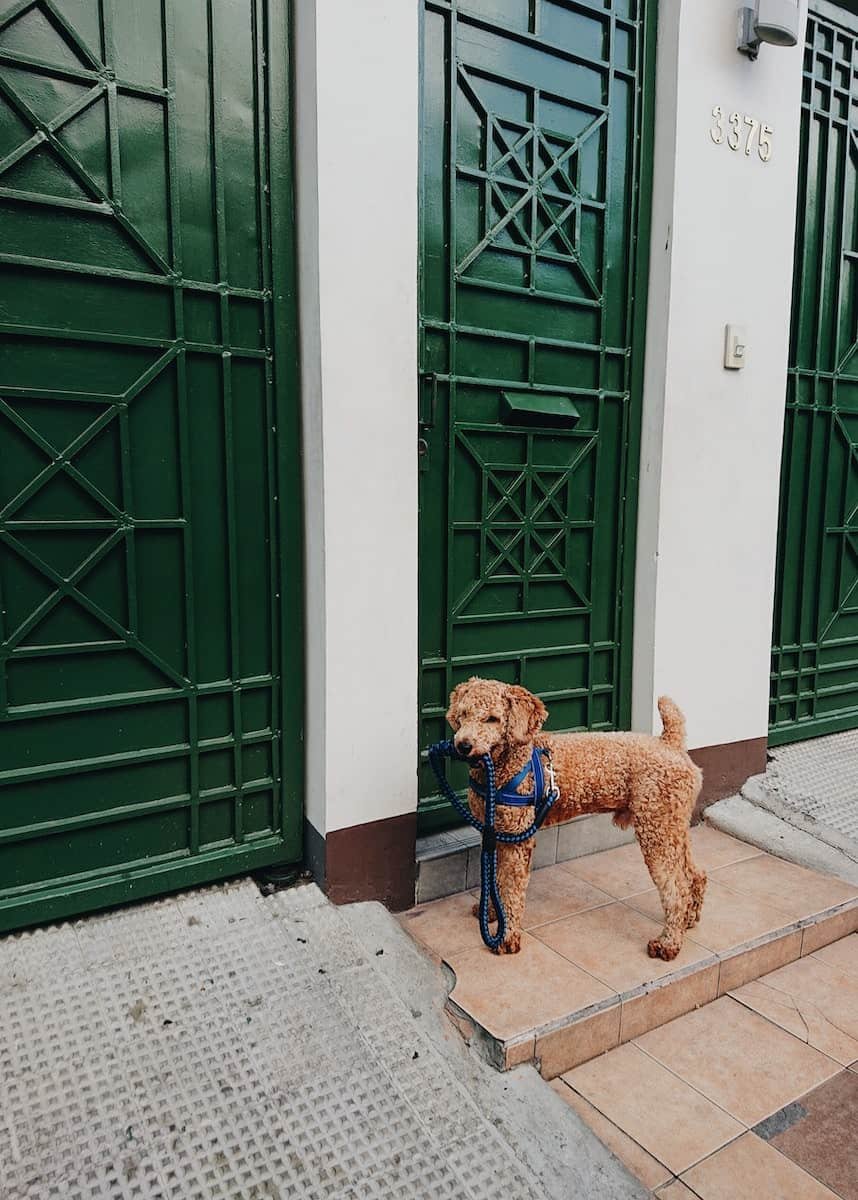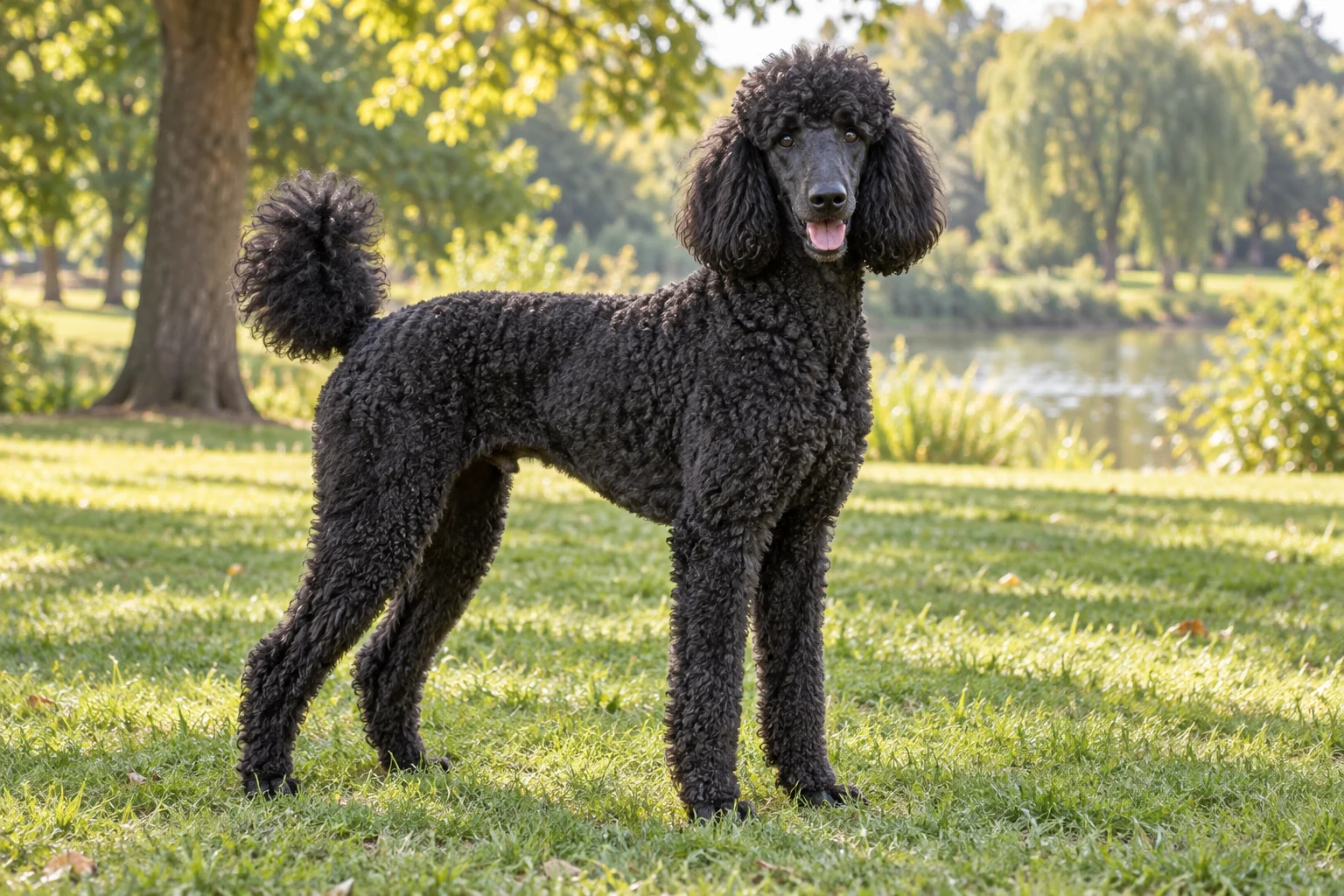

Understanding the Poodle Dog
| Attribute | Toy Poodle | Miniature Poodle | Standard Poodle |
|---|---|---|---|
| Origin | Historical water retriever; exact early origins are uncertain | ||
| AKC Group | Toy Group | Non-Sporting Group | Non-Sporting Group |
| Height | 10 in or less | Over 10 through 15 in | Over 15 in |
| Weight | 4–6 lbs | 10–15 lbs | 40–70 lbs |
| Lifespan | Individual lifespan cannot be inferred from a size label. | ||
| Grooming Needs | Regular brushing and trimming; schedule depends on coat and care needs | ||
| Hypoallergenic | No allergy-free dog breed; low shedding does not establish allergy safety. | ||
The AKC breed overview describes Poodles as active and trainable. These are breed tendencies; ask about the individual dog’s behavior and care needs.
What Is a Poodle?
The Poodle is a dog breed with three AKC varieties: Standard, Miniature and Toy. The standard describes curly or corded coats.
The AKC conformation standard is shared across the three varieties except for height. Individual temperament varies.
The AKC’s history overview connects the breed’s name to the German verb “pudeln,” meaning to splash in water, and identifies the Poodle as France’s national dog.
Some Poodles participate in sports, therapy or service work, as illustrated in the AKC history overview. A breed label does not establish an individual dog’s suitability for those roles.
Unique Qualities of Poodles
The AKC describes Poodles as trainable; learning pace and training needs vary by dog.
Poodles have minimally shedding coats, according to the AKC breed overview. Regular coat care is still necessary; low shedding does not establish allergy safety.
The AKC describes Poodles as active and people-oriented. Discuss activity, companionship and time-alone needs for the individual dog.
Before choosing a family dog, ask about the individual Poodle’s observed behavior with children and other animals.
Poodle as a Water Dog
Poodles have a historical water-retrieving background. The AKC history overview describes larger Poodles performing retrieving work.
The AKC history overview describes historic coat trims that retained hair over parts of the body during cold-water retrieving. This history is not advice about an individual dog’s swimming or cold-water safety.
Ask about the individual dog’s experience and response before considering swimming or water sports. Do not infer a preference from breed.
Origins and History of the Poodle
The breed’s history includes water retrieving and companion roles; surviving accounts do not establish a single, certain origin sequence.
Development in Europe
The AKC’s history overview describes uncertain early origins and associations with several European countries. It should not be read as a settled account of which country developed each variety first.
The AKC describes a water-retrieving background. The available account does not establish the precise sequence of later breeding developments.
The Poodle is France’s national dog. The AKC history account does not establish a simple chronological sequence in which Standard, Miniature and Toy varieties appeared.
If you want more on their history, here’s a good overview of Poodle development in Europe.
Historical Roles and Uses
The AKC describes historical water retrieving and the protective function of retained hair in historic working clips.
The AKC history overview includes examples of circus performance and modern service work, alongside retrieving and companion roles. These examples do not establish a universal progression between occupations.
The AKC history overview gives examples of Poodles associated with French royalty. Those examples do not establish that every Poodle was a status symbol or herding dog.
Their working history is part of the breed’s background, but it does not establish how an individual dog will adapt to a particular home.
Evolution of the Breed Name
The German name “Pudel” is associated with the verb “pudeln.” The AKC history overview also records “Caniche,” or “duck dog,” among historical names.
The English breed name is Poodle; the recorded names alone do not establish a travel or renaming sequence.
The AKC recognizes Standard, Miniature and Toy varieties under a shared conformation standard apart from height.
Poodle Breed Varieties
Poodles come in different sizes. Compare current measurements and individual exercise, grooming and handling needs before choosing a dog.
Standard Poodle
The Standard Poodle is the biggest, standing over 15 inches at the shoulder and usually weighing between 40 and 70 pounds. These dogs are athletic and originally worked as water retrievers.
Ask about the Standard Poodle’s current activity, training and handling needs rather than assuming suitability for a sport or working role.
Poodles of all varieties need activity and stimulation. Plan exercise around the individual dog’s age, health and response, and discuss coat maintenance with a groomer.
For a Standard Poodle, ask the rescue about observed behavior around children and other pets, current training and handling needs.
More details are in this guide to the Standard Poodle.
Miniature Poodle
Miniature Poodles stand over 10 inches through 15 inches at the highest point of the shoulders. AKC’s weight chart gives 10–15 pounds as a breed reference, not an individual target.
Small size alone does not establish apartment suitability. Ask about activity, noise, handling and time-alone needs.
Miniature Poodles also need coat care. Discuss brushing and trimming for the individual coat rather than assuming an easy adjustment to family life.
Ask about the dog’s observed response to people and time alone.
Toy Poodle
Toy Poodles measure 10 inches or less at the highest point of the shoulders under the AKC standard. AKC’s weight chart gives 4–6 pounds as a breed reference, not an individual target.
A Toy Poodle’s small size does not establish its training pace or activity needs.
Before planning travel or a small-home placement, check the dog’s actual measurements, carrier requirements and care needs. Coat maintenance is also part of the plan.
Ask the rescue about the individual dog’s handling needs and experience around children.
Medium Poodle
Medium, sometimes called Moyen, is an FCI variety; it is not a separate AKC variety. Compare the applicable registry’s definitions below.
Under the FCI Poodle standard, Medium Poodles stand over 35 cm through 45 cm at the withers. FCI and AKC variety boundaries differ; do not treat a Medium or Moyen label as an AKC size classification or a guaranteed weight.
Ask about exercise, mental enrichment and grooming for the individual Medium Poodle rather than inferring temperament from the size label.
For a multi-pet home, ask about the dog’s observed interactions with other animals.
Physical Characteristics of Poodles
Poodles are known for their coats and conformation. Kennel-club standards describe breed characteristics; they do not certify an individual dog’s health.
Curly Coat and Colors
The AKC conformation standard describes a naturally harsh, dense curly coat or a coat hanging in cords. A standard describes judging criteria, not every dog’s current coat condition.
Poodles have low-shedding coats, but no allergy-free dog breed exists. Poodle coats come in all sorts of solid colors.
The AKC breed overview lists solid coat colors including white, black, apricot, cream, brown, gray, red, blue and silver; it does not establish their prevalence.
The AKC conformation standard requires an even, solid color at the skin and disqualifies parti-colored dogs in that judging context. This is an event rule, not a health or pet-quality assessment.
Coat length affects maintenance. Ask the groomer to distinguish the brushing, bathing and trimming schedules for the individual coat.
Size and Weight Differences
There are three main sizes: Standard, Miniature, and Toy. Each has its own height and weight range, but they all share similar proportions and traits.
Standard Poodles are the biggest, standing over 15 inches tall and weighing 40 to 70 pounds.
Miniature Poodles stand over 10 inches through 15 inches at the highest point of the shoulders and weigh about 10 to 15 pounds.
Toy Poodles stand 10 inches or less at the highest point of the shoulders and usually weigh between 4 and 6 pounds.
Compare actual measurements and care needs with household limits; a variety label alone does not establish lifestyle fit.
These height boundaries follow the AKC Poodle standard. The weights are breed references, not a prescription or a prediction for an individual dog. AKC’s breed-weight chart lists 40–70 pounds in its Standard row; its separate all-varieties row lists Standard males at 60–70 and females at 40–50 pounds. Ask a veterinarian about an individual dog’s healthy weight.
What to ask a rescue about size
Before applying, ask for current measurements and explain any housing, carrier or handling limit. A size label alone cannot establish whether a particular dog meets it.
- What are the dog’s current weight and shoulder height, and when were they recorded?
- Is the dog an adult or a puppy, and how certain is the age estimate?
- Is the breed description documented or an estimate?
- What records or observations support any adult-size estimate?
- What care or handling needs should this household discuss?
A week-by-week growth forecast needs a traceable dataset, method and uncertainty range. The breed references above do not supply that evidence. Ask about the individual dog’s records rather than treating a reference weight or simple multiplier as a guaranteed target.
Use the Poodle Rescue Directory to investigate organizations, and verify their current service area, available dogs and process directly.
Breed Standards
The AKC standard describes body shape, coat, proportions and movement for conformation judging. It does not certify a dog’s health.
A poodle should have a squarely built body. Its height from shoulder to ground should be about the same as the length from chest to rear.
The head is rounded, and the muzzle is long and straight. Poodles have dark, oval eyes that look alert.
Ears hang close to the head. The AKC standard describes both curly and corded coats.
The AKC conformation standard describes coat color and movement for judging. Check the applicable registry and event rules rather than assuming that every show uses the same criteria.
If you want more details on breed standards, visit the AKC Poodle breed page.
Poodle Temperament and Personality
The AKC describes active, trainable and people-oriented breed tendencies, while emphasizing that dogs within the breed differ.
Intelligence and Trainability
No intelligence ranking establishes how a particular dog will learn. Ask about existing skills and training needs.
Consider training and enrichment suited to the individual dog; participation in obedience or agility does not establish a universal preference or result.
Set realistic learning goals and assess progress individually; breed does not predict how quickly a complex task will be learned.
The AKC recommends consistent, positive training routines. Choose activities suited to the individual dog.
Social Nature and Behavior
The AKC describes Poodles as people-oriented. Ask about this dog’s interactions with people, other animals and periods alone.
A Poodle’s behavior with children or other animals should be assessed individually. Ask about observed interactions, and plan appropriate supervision.
Discuss socialization and training with an appropriately qualified professional; neither establishes a guarantee against fear or shyness.
Suitability for Families
A Poodle can be a family companion, but the fit depends on the individual dog and household. Ask about behavior with children and handling needs before committing.
Discuss the household routine and the dog’s observed needs before placement; trainability does not guarantee an easy adjustment.
Compare the dog’s actual size and needs with your household. Low shedding alone does not establish allergy safety.
Health and Genetic Conditions in Poodles
Available health records can help identify questions to discuss with a veterinarian. A breed label, diet or routine care does not guarantee freedom from inherited disease.
Health Testing Records and Breed Concerns
The PCA’s December 2024 health statement identifies testing recommendations by variety and other health concerns. Ask for available hip, eye and other evaluation records appropriate to the variety. A veterinarian can explain their relevance to this dog.
Addison’s disease is among the other concerns listed by the PCA. A list of breed concerns is not a diagnosis for an individual dog.
Ask which examinations and tests were performed, when, and whether follow-up was recommended. Do not treat a test for one condition as a general health guarantee.
The PCA statement includes condition-specific DNA tests and clinical evaluations; discuss available records with a veterinarian.
Lifespan and Longevity
Life expectancy varies by individual. Ask the rescue or breeder for the dog’s age estimate and available health records.
A variety label alone cannot establish how long an individual dog will live. Have a veterinarian interpret the dog’s health records and current needs.
Testing information can inform breeding decisions, but available records do not guarantee that an individual dog will avoid inherited illness.
Discuss the dog’s current needs and care plan with a veterinarian.
Preventive Health Care
Have a veterinarian advise on examinations, vaccinations, parasite control and any tests appropriate to the individual dog.
Ask for documented health testing appropriate to the variety. The PCA’s December 2024 statement includes specific DNA tests and clinical evaluations; it does not list an Addison’s DNA screening test. A veterinarian can interpret the records.
Questions for the veterinarian:
- What examination schedule is appropriate for this dog?
- Which vaccinations and parasite-control measures are appropriate?
- Which variety-specific screening records are available, and what do they establish?
- What diet and weight plan is appropriate for this dog?
- Which changes or symptoms should prompt veterinary attention?
Use available records to discuss unresolved questions with a veterinarian. The PCA health resources provide breed-level context.
Grooming and Coat Care
Poodle coat care depends on coat condition and length. The AKC grooming guidance discusses brushing, trimming and routine care.
Grooming Needs
Long coats may require daily brushing to prevent matting. Discuss the individual coat’s needs with a groomer.
Discuss a suitable trimming and bathing schedule with a groomer; coat length and maintenance affect the interval.
Ask the groomer which services are included, and what brushing, nail, ear and dental care should be handled separately.
Ask the groomer to demonstrate how to check the individual coat for tangles and mats, including areas affected by collars or movement.
Coat care and allergy considerations
Poodles have curly, low-shedding coats. According to the American College of Allergy, Asthma & Immunology, all dogs produce allergens and no allergy-free dog breed exists.
Regular grooming helps maintain the coat; a bathing schedule alone cannot establish allergy safety.
For personal allergy questions, consult an allergist rather than choosing a dog by its breed or coat label.
Styling and Maintenance
Poodle clips include puppy and continental styles in AKC conformation rules. Discuss a practical maintenance trim with the groomer; the word “puppy” here describes a clip, not acquisition advice.
Ask a groomer to demonstrate appropriate home brushing and other routine care. Delicate-area clipping should not be assumed to be required beginner care.
Ask a groomer for help with mats, especially near the skin, rather than attempting a hurried removal.
Agree on a grooming and home-care routine suited to the individual coat.
Activity Level and Exercise Requirements
The AKC describes Poodles as active dogs. Choose activity and enrichment around the individual dog’s age, health and response.
Physical Activity Needs
The AKC breed overview describes Poodles as active dogs that need activity and stimulation.
Plan exercise and enrichment around the individual dog’s age, health and response. Ask a veterinarian about suitable activity, particularly for puppies, senior dogs or dogs with health conditions.
Adjust activities with professional guidance when age or health changes.
Discuss suitable walks, play or other activities with the rescue and veterinarian rather than using a variety label as an exercise prescription.
Mental Stimulation
Consider training sessions, puzzle toys or other enrichment suited to the individual dog. This is not a claim that mental and physical exercise are equivalent.
Games such as hide-and-seek or scent work may be options if suitable for the dog; they do not guarantee prevention of unwanted behavior.
If behavior concerns arise, discuss the dog’s needs with an appropriately qualified professional rather than assuming boredom is the cause.
Suitable Activities
Possible activities to discuss for the individual dog include:
- Walks appropriate to the dog
- Fetch games
- Agility training
- Swimming, only if suitable for the dog and setting
- Interactive toys
Choose activities suited to the individual dog; do not infer session preferences from a variety label.
Tailor activity choices to the dog’s age, health and response; ask for professional guidance when needed.
Poodle Training and Intelligence
The AKC describes Poodles as trainable, but breed does not predict an individual dog’s learning pace.
Ask about the dog’s current skills, handling needs and training history rather than relying on a breed ranking.
Obedience Training
The AKC describes Poodles as trainable. Set realistic training goals for the individual dog.
Use consistent, positive training and assess progress individually.
Build training goals around the individual dog’s existing skills and response to instruction.
Keep training goals and session length appropriate to the individual dog.
Performance in Dog Sports
The AKC history overview documents individual Poodles participating in canine sports. Participation is not evidence of a breed-wide competitive advantage.
Assess readiness for a sport with an appropriately qualified trainer; do not assume speed or interest from breed.
Match sport goals to the dog’s health, skills and observed preferences.
Sport results belong to individual dogs; a variety label does not predict ribbons or performance.
Tips for Effective Training
Use consistent, positive training routines and goals appropriate to the individual dog, as recommended in the AKC breed overview.
Discuss session length, rewards and enrichment with a qualified trainer; no routine guarantees prevention of unwanted behavior.
Discuss socialization and training concerns with a qualified professional. Avoid treating a breed label as evidence about the effectiveness of every training method.
Living with a Poodle
A Poodle’s suitability for a home depends on the individual dog’s observed needs and the household’s care capacity.
Adaptability to Various Homes
Before choosing a dog, compare the household’s space, routine and care capacity with the individual Poodle’s needs.
Measure the available space and discuss handling, exercise and noise needs with the rescue; small size alone does not establish apartment suitability.
Ask about suitable walks and play for the individual dog. Low shedding is not a guarantee of allergy safety.
Verify how exercise, coat care and other needs can be met in the proposed home.
Ask how the dog’s activity and care needs can be met in the proposed home.
Interaction with Other Pets
Ask the rescue about the dog’s observed interactions with other pets.
Plan careful introductions and supervision for the animals involved.
Discuss any observed guarding, fear or other behavior concerns before placement.
Ask about the dog’s history around smaller animals and arrange careful, supervised introductions.
Discuss training and introduction needs for the individual animals.
Travel and Lifestyle Considerations
Ask about the individual dog’s travel history and response to new settings.
Allow time for adjustment and watch for signs of stress.
Check the venue’s pet policy and transport or carrier requirements before travelling; breed does not establish access permission.
If you’re traveling for a few days, don’t forget grooming tools or their favorite toys. Watch for signs of stress, and give your poodle time to adjust.
Sticking to regular feeding, potty breaks, and sleep schedules helps them keep their routine, even on the road.
Choosing and Acquiring a Poodle
Before buying or adopting a Poodle, verify available records and discuss the individual dog’s needs.
Reputable Breeders
Request available health records and test results, and ask how you can verify the dog’s living conditions and care practices.
Use breeder resources as a starting point, then inspect available health records and ask about practices directly. A listing or registration is not an endorsement of ethics or a health guarantee.
Ask about paperwork, placement practices and opportunities to meet the dog. Foster, rescue and biosecurity arrangements can affect visits; a visit alone does not establish ethics or health.
Research the seller or organization and discuss unresolved health or behavior questions before committing.
Rescue and Adoption
The Poodle Rescue Directory can help identify organizations to investigate. Ask why an individual dog is being placed and what is known about its history.
Ask the rescue about its matching process, current fee and included services. Do not assume vaccinations, neutering or examinations are included.
Discuss observed behavior and the rescue’s matching process. Neither a meeting nor a matching process guarantees family compatibility.
Review questions before adopting a rescue Poodle, then verify the organization’s current process directly.
Cost and Ownership Considerations
Owning a poodle means more than just paying the adoption or purchase fee. You’ll need to budget for food, grooming, vet care, training, and supplies.
Include grooming in the budget and request a schedule and current quote for the individual coat.
Request current fees directly and ask what they include. Budget separately for ongoing care and unexpected veterinary costs.
Adoption is a long-term commitment. Ask about the individual dog’s age estimate and care needs before budgeting.
Frequently Asked Questions
Poodles come in different sizes and have individual health and care needs. The questions below focus on the records and observations to request.
What are the different sizes of poodles recognized by kennel clubs?
The AKC Poodle standard defines Toy as 10 inches or less, Miniature as over 10 inches through 15 inches, and Standard as over 15 inches, measured at the highest point of the shoulders. Other registries use different boundaries; check the applicable standard.
What costs should I ask about before acquiring a Poodle?
Request current fees directly from the rescue or breeder and ask what they include. Budget separately for grooming, veterinary care, food, training and supplies.
Don’t forget about grooming, food, and vet care—those add to the total.
What should I ask about a Toy Poodle’s age and long-term care?
Ask the rescue or breeder for the dog’s age estimate and available health records, and discuss care needs with a veterinarian. A Toy label does not establish how long an individual dog will live.
Can Poodles be suitable pets for families with children?
Poodles can suit family homes, but assess the individual dog’s temperament, history and behavior with children and other animals. Ask the rescue about observed interactions; a breed label does not guarantee compatibility.
Ask about the individual dog’s training and socialization history.
What is the origin of the Poodle breed?
The Poodle has a historical association with water retrieving and is France’s national dog. Its exact early origins are uncertain.
The AKC’s history overview provides historical context, including the uncertainty about early origins.
What health records should I ask about for a Miniature Poodle?
The PCA recommends Miniature breeding-stock checks for prcd-PRA, eyes, patellar luxation and hips. Ask for available records and have a veterinarian explain what they do and do not establish for the individual dog.
A veterinarian can advise on an individual care plan; available testing does not guarantee future health.
See the PCA’s dated health statement for the recommendations referenced here.